
Blog
What is hybrid mail, and when does it make sense for UK businesses?
Hybrid mail takes documents you've created digitally — invoices, statements, notices — and prints, encloses, and posts them from a UK facility the same day. A clear-eyed guide to when it earns its place in a UK business, and what to look for in a provider.
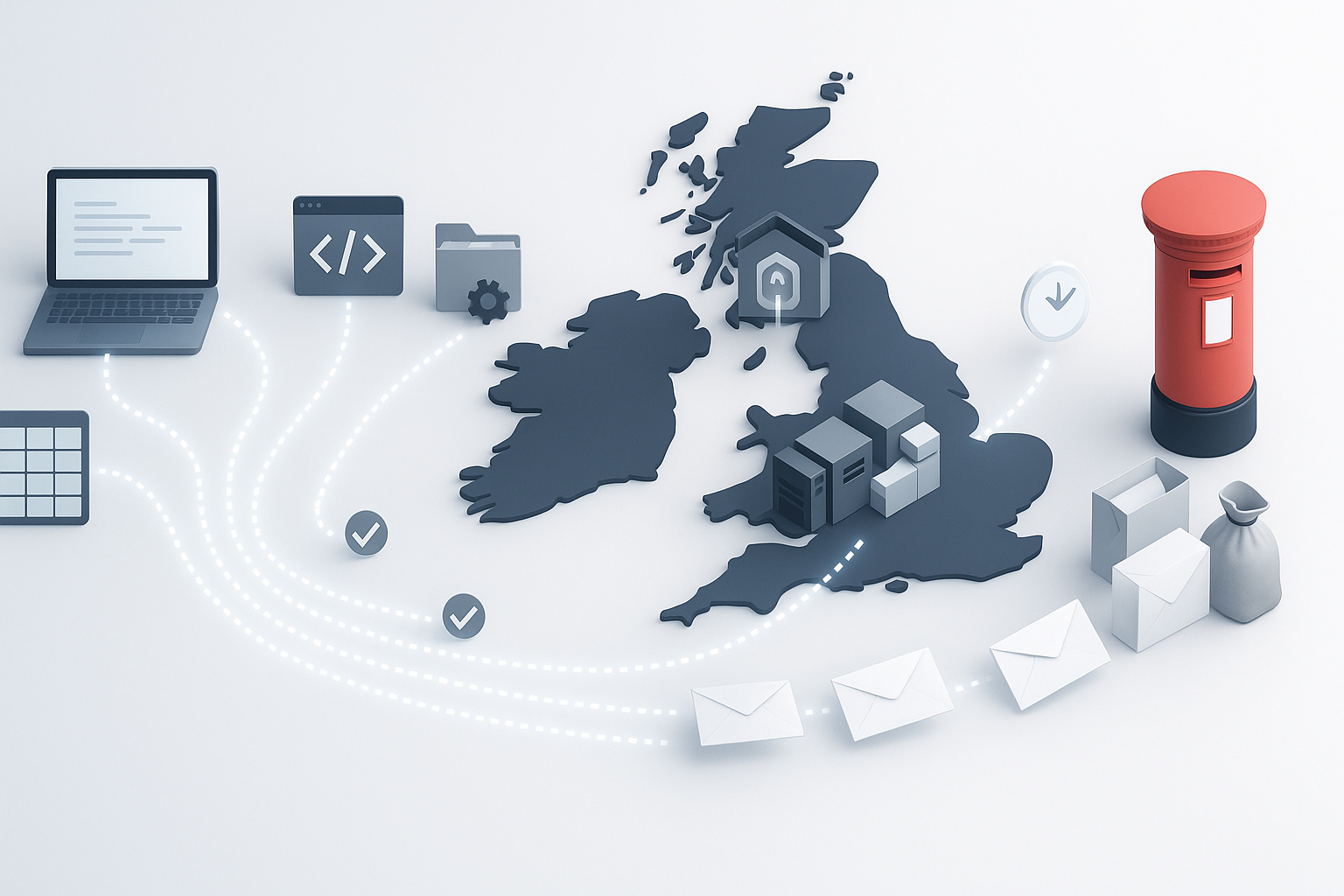
Hybrid mail is a service that takes documents you've created digitally — invoices from your accounting software, letters from Word, statements exported from a system — and prints, encloses, addresses, and posts them on your behalf from a UK facility, usually the same working day you upload them. You upload the file; a specialist handles the printing, the envelope, the stamp, and the handover to Royal Mail.
For UK businesses sending more than a few dozen letters a month, the gap between doing this in-house and doing it properly is bigger than most finance teams realise — and it's not mostly about the cost of stamps.
How hybrid mail actually works
In practice, the workflow is unglamorously simple, which is the point. The usual flow looks like this:
- You create your document in whatever tool you already use — Word, Google Docs, your accounting software, your CRM, a spreadsheet export.
- You send it to the hybrid mail provider. Depending on the provider, this can be a web dashboard upload, a watched folder, a virtual "print to post" driver on your computer, a CSV upload for bulk jobs, a connector to tools like Zapier or n8n, or a direct API call from your own systems.
- The provider's facility prints the document, folds and encloses it in an envelope, addresses and stamps it, and hands it over to Royal Mail.
- You get a record — and sometimes tracking — for every letter that went out.
The whole process, from you clicking "send" to your letter being in the Royal Mail network, usually takes minutes rather than hours, provided you submit before your provider's afternoon cut-off.
If you're used to someone in the office printing off a batch of invoices, folding them, stuffing envelopes, writing addresses, sticking on stamps, and driving to the post office — hybrid mail collapses that entire chain into an upload.
When hybrid mail makes sense for your business
Hybrid mail earns its place when any of the following is true:
- You send more than ~20 business letters a month — invoices, statements, notices, chase letters, customer correspondence — and someone on your team is doing that by hand.
- You work in a sector where physical mail is still expected or required: property management, legal, accountancy, healthcare, insurance, local government, utilities, membership organisations.
- Your post goes out from more than one site, and each site has its own little mailroom setup — different printers, different franking machines, different stamp drawers.
- You want a single audit trail showing every letter the business sent: who, when, to whom, and what went in the envelope.
- You've ever missed a postal deadline because someone was off sick, on holiday, or just busy.
- Your accounting, CRM, or property management software can trigger letters automatically — and you'd like to use that instead of exporting PDFs and posting manually.
Hybrid mail is not the right fit for a few situations. If your letters genuinely need bespoke finishing — oversized formats, unusual paper stocks, complex inserts, multi-piece packs — a traditional print bureau is still a better route. And if you're running physical marketing campaigns where creative and print quality are the whole point, a direct mail agency does that better than a hybrid mail platform will.
But for day-to-day operational post — the stuff that has to go out, correctly, repeatedly, often — hybrid mail is almost always the more sensible setup.
The real reason to switch, and it's not postage
The obvious question is cost, so let's deal with it first. Stamp-for-stamp, hybrid mail can be cheaper than doing it yourself — but not always, and not by enough on its own to motivate a change. The real economics kick in once you account for the things that don't show up on a receipt: the staff time spent folding and stuffing envelopes, the printer maintenance, the toner, the paper, the envelopes, the franking machine lease, the trips to the post office, and the opportunity cost of whoever's doing that work instead of something higher-value.
We've written about the hidden cost of in-house mail in more detail — the short version is that most finance teams comparing the two are comparing postage prices when they should be comparing total cost per letter sent, including labour. Do that, and the numbers usually surprise people.
The other, less quantifiable reason businesses switch is simpler: nobody enjoys doing the post. It's repetitive, error-prone, and invariably falls to whoever can least argue their way out of it. Hybrid mail takes that job off the team entirely, which matters for morale almost as much as the pound-per-letter comparison.
What to look for in a UK hybrid mail provider
The providers in this market are not all the same, and the differences matter. Before you commit to one, there are a handful of things worth checking.
UK production. If your post includes anything regulated — personal data under GDPR, financial correspondence, patient or client information, legal notices — the physical facility that prints your documents should be in the UK. Some providers route printing through overseas partners, which adds data-protection complexity most UK businesses don't want. A clear statement that production stays on UK soil should be table stakes.
ISO 27001 certification. ISO 27001 is the international standard for information security management. For any hybrid mail provider handling customer data, it's a baseline credential rather than a nice-to-have. Ask for the certification reference and check it's current. Providers serious about regulated-sector customers will often hold multiple ISO certifications — 9001 for quality management and 14001 for environmental management alongside 27001.
Multiple submission routes. Different jobs suit different methods. An ad-hoc letter is best done through a dashboard upload. A recurring monthly statement run is better as a CSV, a Zapier automation, or an integration with your accounting software. A team that lives in Word might prefer a print driver that sends their document to post instead of to a physical printer. Developers building letters into a billing platform want an API. A good provider offers all of these, not just one — which lets you start simply and add automation as you need it.
Same-day dispatch and a clear cut-off. The whole point of hybrid mail is speed and convenience, so the provider should commit to same-day printing and dispatch when you submit before their afternoon cut-off. What time is that cut-off? Is it an aspiration or an SLA? What happens if you miss it? Any provider who's vague about this is worth being cautious about.
No minimums, no contracts, clear pricing. For a small team sending 50 letters a month and a larger one sending 50,000, the fair pricing structure is the same: pay per piece, see the price, no subscription, no minimum volume, no annual commitment. Anything else is an attempt to lock you into a commercial arrangement that suits the provider more than it suits you.
Support that is actually available. At some point, an envelope will come back, an address will be wrong, a PDF will be malformed, or a letter will need to be stopped mid-flight. Which is fine — these things happen. What matters is whether the provider has a real person who'll pick up when they do.
Getting started
The cheapest way to find out whether hybrid mail works for your business is to send one letter through a provider and see what the process actually feels like. Not watch a demo video. Not book a call with sales. Upload one invoice, one reminder, one notice — and see whether it was genuinely easier than doing it yourself.
We built Intelliprint to make that first letter as frictionless as it can be. Production is in the UK, we hold three ISO certifications including 27001, pricing is per piece with no minimums or contracts, and we support every submission route — dashboard upload, print driver, CSV, Zapier, n8n, and a full API — so you can start simple and automate as you grow. Most of our largest customers started with a dashboard upload and were on the API six months later; a few others have stayed on dashboard-and-CSV for years because that's what fits their operation.
Create a free Intelliprint account — the free credits cover your first letter or two, you don't need a card, and you'll see end-to-end how it works in about three minutes. If you'd rather do the maths first, the savings calculator compares your current in-house costs to hybrid mail for your own volume.
Frequently asked questions
How long does a hybrid mail letter take to arrive?
If your letter is printed and posted the same day via first-class Royal Mail, it will typically arrive the next working day. Second-class takes 2-3 working days in normal conditions. Signed-for and tracked options are usually available at a surcharge.
Is hybrid mail secure for sensitive customer data?
It can be, but the provider's credentials matter. Look for UK-based production (so data doesn't leave the country), ISO 27001 certification (so information security is independently audited), and a GDPR-aligned data handling policy. If you're in a regulated sector, also ask whether the provider can sign a data processing agreement.
What does hybrid mail cost per letter?
Typical UK hybrid mail pricing sits between 50p and £1.50 per letter depending on postage class, page count, colour vs black-and-white, and envelope size. Most providers publish per-piece pricing publicly — if they won't give you a number without a call, that itself is a signal.
Can I integrate hybrid mail with Xero, QuickBooks, or my CRM?
Yes, usually through one of a few routes. Some accounting packages have direct connectors (see our Xero integration for an example). For systems without direct integrations, tools like Zapier and n8n can bridge the gap, and an API is always available for custom workflows. If your software exports PDFs, there's a way to get those letters posted automatically.
Can I send a single letter, or do I need to commit to a monthly volume?
You can send a single letter. A good hybrid mail provider has no minimum order and no subscription — pay for what you send, nothing else.
What happens if an address is wrong or the letter comes back?
Good providers flag likely bad addresses before printing (using Royal Mail's postcode database), and have a returns-handling process for letters that do come back. Ask about this specifically before signing up — some providers offer returns handling as part of the service, others charge extra or leave it to you.